


2026 Digital Trust Industry Pain Report

The industry's first digital trust pain report is here
For most of the internet's history, there was a reasonable assumption underneath every security program ever built. That assumption was simple: the internet is a human space. Humans visiting websites. Humans opening emails. Humans interacting with brands. When something goes wrong, a human does it.
That assumption is now broken.
More than half of all global internet traffic is generated by bots. Agentic AI has flooded the open web with non-human infrastructure, synthetic personas, automated domains, and AI-generated scam campaigns, at a scale that dwarfs anything human teams were built to defend against. Adversaries understood this shift before defenders did. They built for it. And they are now running coordinated attacks against brands, executives, and institutions that are still operating security programs designed for a different internet.
This is not a prediction. It is what we observed across 75 organizations and 20+ industry verticals in building the 2026 Digital Trust Industry Pain Report.
The Digital Trust Kill Chain
The report introduces the Digital Trust Kill Chain, the industry's first structured framework for mapping how adversaries systematically dismantle organizational trust, from initial reconnaissance through to final monetization, across eight distinct stages.
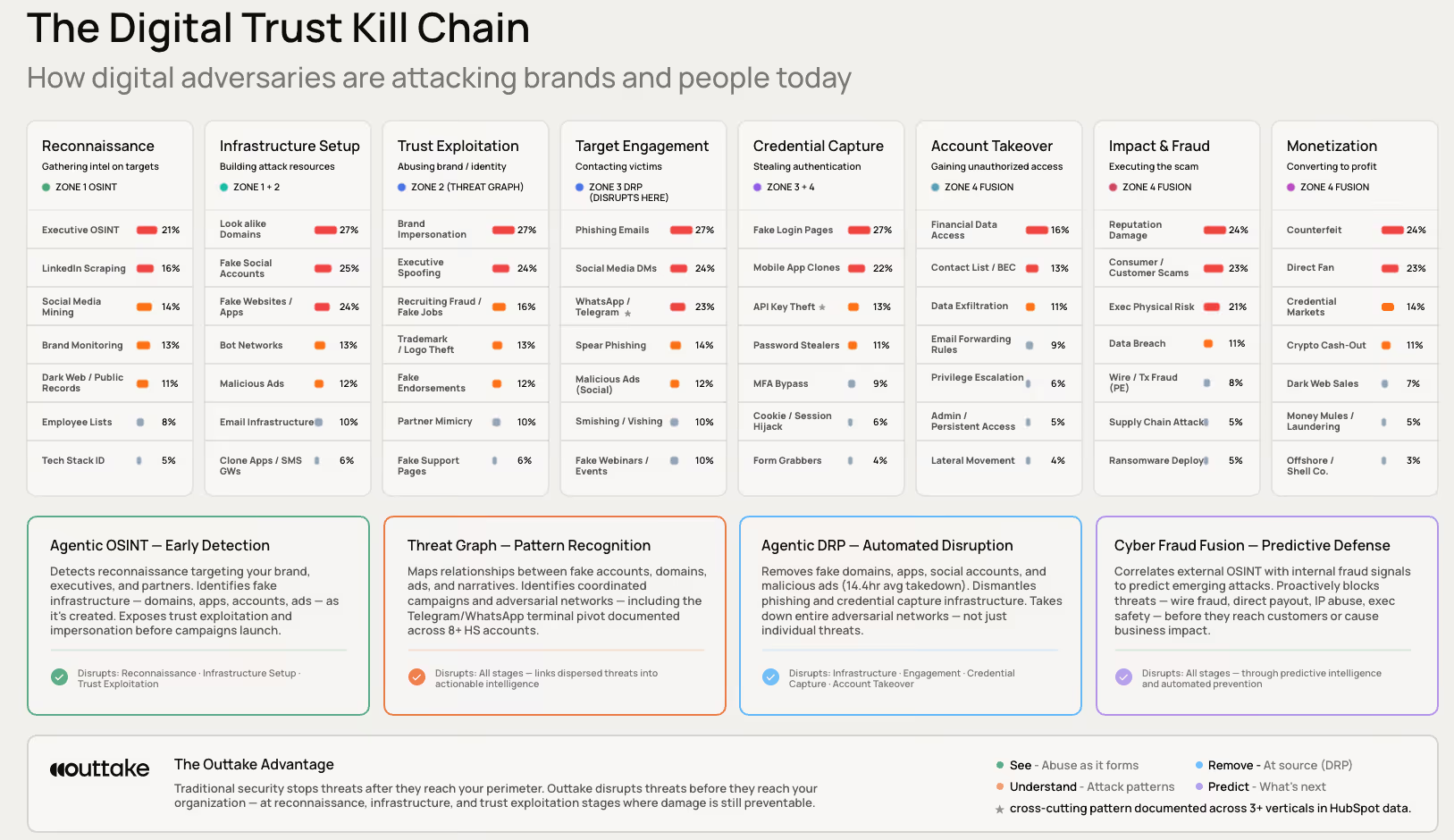
The Digital Trust Kill Chain: 8 stages mapping how adversaries move from initial reconnaissance to final monetization, with observed technique prevalence from 75 organizations across 20+ industry verticals.
Traditional kill chains model network intrusion. This one models the exploitation of brand identity, executive credibility, and institutional reputation as attack vectors. Understanding which stage an adversary is operating in determines the entire response strategy. The organizations that get hurt fastest are almost always the ones that do not know which stage they are already in.
What the data shows
The failure point is not detection. It is response speed.
Organizations can see threats forming. The consistent failure is what happens next. Alert queues overflow. Manual triage collapses under volume. The campaign runs before a response is organized. Across every vertical in our dataset, this was the single most consistent failure point. The attack has already automated. The defense has not.
Executive impersonation appears in 12 of 20 verticals.
Not as a secondary concern. As a primary or secondary pain category across industries as different as financial services, healthcare, live events, and AI labs. The question is no longer whether your executives are targets. The question is whether you have any visibility into what has already been built in their names.
Brand and trust identity are the primary attack surface.
Adversaries are not breaching systems. They are impersonating brands, cloning executive identities, and building fake infrastructure that operates in the space between an organization's firewall and its customers' trust. That space is where most current security tooling has no coverage.
Platform blind spots are confirmed and expanding.
Telegram, WhatsApp, TikTok, Bluesky, and emerging AI agent platforms are dead zones for most security tooling. Coordinated fraud campaigns initiate on public social platforms and complete on encrypted messaging apps, entirely outside the view of conventional detection. By the time a single threat surfaces through traditional channels, the full campaign has been operational for hours.
What differs by industry
The threat is not uniform. The breakdown looks different depending on where you sit.
Financial services face a convergence problem. The highest-value targets meet the most sophisticated adversary toolkits. Private equity firms are dealing with domain spoofing designed to intercept LP wire transfers. Retail banks are drowning in alert volume where the failure is prioritization, not detection.
Enterprise technology is watching its own tools get weaponized against it. Developer platforms, cloud APIs, and AI systems are being exploited by the same adversaries targeting the organizations that built them. Fake GitHub repositories, Telegram blind spots, and synthetic employee personas are the dominant attack patterns.
Consumer brands are losing narrative control on platforms their security teams do not monitor. Coordinated fraud campaigns operating at industrial scale are a recurring operational reality, not an edge case.
Healthcare and government entities face something worse than reputational damage. The attacks in our dataset translate directly into physical safety consequences, a dimension most security programs were never built to address.
Why this report didn't exist before
Most security vendors publish reports. Threat forecasts assembled from analyst predictions. Fraud trend studies that count malicious domains. Single-vertical briefs covering one industry for one quarter. Useful. But they share a fundamental limitation most vendors won't say out loud.
They can only report on what their tools can see. You define the threat, describe what to look for, the system returns matches. That model works for threats you have already anticipated. It does nothing for the campaign spreading across a platform you were not monitoring, the fake executive persona that does not mention your brand by name, or the coordinated scam infrastructure that was fully operational before your first alert fired.
The Outtake platform runs autonomous agents continuously across social platforms, domains, app stores, ad networks, messaging apps, and the dark web, classifying threats as they form, not after they have already run. That continuous coverage is what made a dataset like this possible, and why a report like this has not existed until now.
Read the full report
The full report maps six pain categories across every major vertical, shows which stage of the Digital Trust Kill Chain each industry is most vulnerable to, and surfaces the cross-cutting strategic implications that hold regardless of where your organization sits.
Ungated. No form. No friction. Because the industry needs this data and we built it to be used.
Read the Report at outtake.ai/labs
Want to see how Outtake maps and dismantles the threats documented in this report for organizations like yours?
Book a Demo at outtake.ai/contact