

Executive Impersonation is a security problem.


Start with where the attack actually lives
For a decade, security invested in defending the inside, and it worked. As endpoints, identities, networks, cloud, and email became genuinely hard to breach, attackers did the rational thing and moved to the one place those defenses do not reach: the open internet, where your executives speak, your brand is represented, and your customers go looking for you.
That is also where anyone can stand up a convincing version of you, whether it is a fake profile, a lookalike domain, or an account using your CEO's name and photograph to talk to your customers as though it were the company itself. Because none of this touches your network or registers in your SIEM, the security stack you have spent a decade hardening was simply never built to watch it, and that single fact explains most of what follows.

Why it is accelerating
Two forces are turning executive impersonation from an occasional annoyance into a standing risk, and the first of them is economic. Attacking the open internet keeps getting cheaper at the same time that defending it keeps getting more expensive, because AI now lets an attacker generate impersonation profiles and spoofed pages by the hundreds, in minutes, at almost no cost, while each of those fakes still costs your team real hours to find and remove. That asymmetry does not hold steady over time; it compounds against the defender.
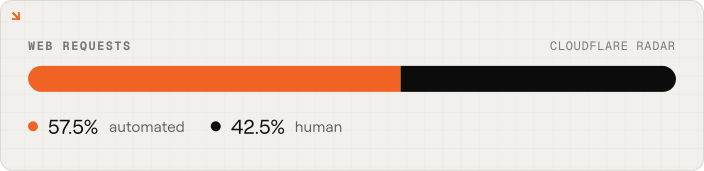
The second force is structural. In June 2026, automated traffic passed human traffic on the internet for the first time, with bots reaching 57.5% of web requests against 42.5% from humans (Cloudflare Radar, June 2026), which means the web your executives live on, and the web your own AI agents now read, is increasingly machine-generated. In an environment like that, manufacturing a convincing fake identity is trivial and the volume of fakes is no longer bounded by human effort, so this is not a problem that shrinks as awareness grows. It grows as the cost of faking you keeps falling.

The scale is already here
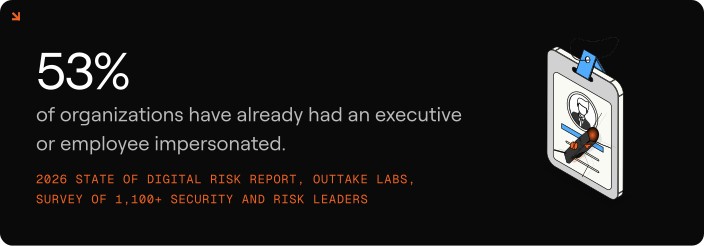
None of this is a forward-looking projection, because more than half of organizations, 53%, have already had an executive or employee impersonated (2026 State of Digital Risk Report, Outtake Labs, survey of 1,100+ security and risk leaders), which puts it well past the point of tail risk and squarely into base rate. What makes that number worse is how most organizations find out: reactively, when a customer runs into a fake account and emails support, or a partner forwards a suspicious message. The company learns about the impersonation from the outside, after it has already been working, rather than finding it first.

The ownership gap is the real vulnerability
The reason a manageable problem so often becomes an unmanaged one comes down to ownership, because in most organizations no single team owns executive impersonation and every team sees only its own slice of it. Comms sees a fake profile of the CFO and treats it as a reputational issue for PR, legal sees a cloned domain and files it as trademark infringement, and security frequently never sees any of it at all, since none of it registers on the tools security actually monitors.
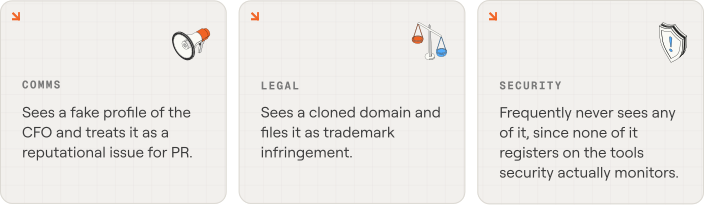
The result is three teams each holding a piece of the same coordinated attack, with no shared view and no one accountable for the outcome, so when a fraudulent wire request goes out under the CEO's name or a fake account starts messaging customers, the organization discovers in real time who owns this, and the answer is usually nobody. The deeper issue here is not a tooling gap but an ownership gap, because you can buy all the capability you want and it will still sit unused between departments if no one is accountable for the result.
Impersonation belongs with security because of what the attacker is ultimately after. It is a delivery mechanism, and the payload behind a fake executive account is the same set of outcomes security already defends against every day: credential theft, wire fraud, and extortion. Comms and legal still have real roles to play, but the outcome an impersonation drives toward, money moved or trust broken, is a security outcome, and ownership should sit with the function accountable for it.

Put your people where they are actually needed
Once an organization accepts this as a security problem, the natural instinct is to point the team at it manually, watching the surfaces by hand and working a review queue one takedown at a time, and that turns out to be the wrong use of good people. Every fake costs the attacker almost nothing to produce, so the volume arrives faster than any team can process it by hand, and asking talented analysts to keep pace means spending their hours on repetitive triage, the work that scales worst with human effort and burns out the people doing it.
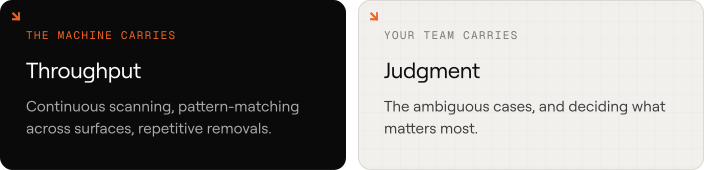
The answer is not fewer people but better-equipped ones, with the machine carrying the volume, the continuous scanning, the pattern-matching across surfaces, and the repetitive removals, so that your team is freed to do what only humans do well, which is to exercise judgment on the ambiguous cases and decide what matters most. Human in the loop for judgment, not for throughput. Classic digital risk protection got this backwards, because it was built for a slower internet and puts people in the throughput role, manually operating disconnected tools, which gives it a structural ceiling that caps what your team can accomplish no matter how skilled they are. The goal is to lift that ceiling off your people, not to add more hands beneath it.

How to think about defending it
Four things to get right, whatever you end up buying.
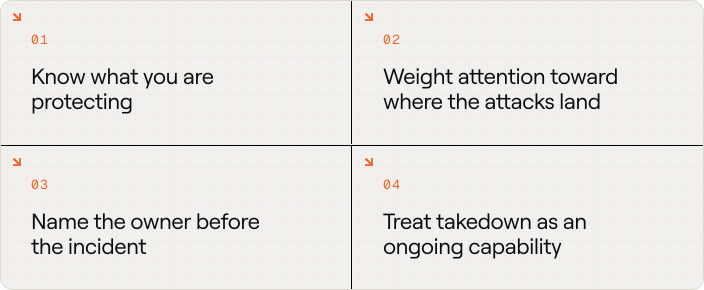
Whatever tools you eventually choose, a few principles hold. The first is to know what you are actually protecting, which means mapping the executives who are visible enough to be worth impersonating, and remembering that visibility is not headcount or title but public presence, speaking history, wire authority, and how much of a person's face and voice already exists in the open. From there, you weight your attention toward where the attacks actually land, because impersonation concentrates rather than spreading evenly, and your coverage should follow that concentration instead of treating every channel as equally urgent.
Just as important is naming the owner before the incident rather than during it, which does not require a new team so much as one person in security with a standing line to legal and comms, provided everyone knows that person exists ahead of time. Finally, treat takedown as an ongoing capability rather than a one-time scramble by measuring how long removal takes and using each removal to make the next one faster, something most organizations have never done because they have never treated it as an operational number. The end state that makes all of this work is architectural, and it is where Next- Generation Digital Risk Protection comes in, turning a single signal such as one fake account or spoofed domain into the full picture of the operation behind it and taking the whole thing down as an automated loop that improves over time, so that the question stops being how large your team is and becomes whether your system gets better on its own.

Go deeper
We wrote a field guide for the security, brand, and executive protection leaders who want to stop discovering these attacks after the fact. It walks through how to build a threat profile for your highest-risk executives, how to weight coverage toward where impersonation concentrates, how to assign clear ownership, and how to measure takedown as an operational metric, and it draws on what Outtake observed across the executives we monitor and protect, cross-checked against public industry and third- party research including FBI IC3 and the Verizon Data Breach Investigations Report.

Stop finding out from your customers
Build a threat profile for your highest-risk executives, weight coverage toward where impersonation concentrates, and measure takedown as an operational metric.