


Newer is not next-generation

84% of security and risk leaders have had a material digital risk incident.[1] The number that matters sits underneath that one. Most of them learned about the incident from a customer, a partner, or an employee, not from a control they owned. The attack had already run its course by the time it reached the people paid to stop it.
That is the shape of external risk now. It begins outside your network, on infrastructure you do not own and cannot see, and it reaches you as a consequence, not an alert.
A customer disputes a charge from a store you never opened.
A candidate pays a recruiter for a job you never posted.
A partner wires funds against an invoice from an executive who never sent one.
None of it crosses your firewall. All of it lands on you. People reported losing $3.5 billion to impersonation scams in 2025 alone.[2]
This is the direction of travel, not a passing wave. As AI hardens software, breaking in through a vulnerability only gets harder, and the surest way through a locked door becomes convincing whoever holds the key to open it. More and more, that key holder is an agent acting for a person rather than the person. The fight is moving off your network and onto the open internet, where anyone can stand up something that looks like you, and the thing being exploited is trust.
Why the tools already in place keep missing it
Digital Risk Protection is not new. It is an established line item with real budgets behind it, and over the years it has moved through three generations. What separates them is not how new a tool looks, but how much of the work the platform carries for you, versus how much still runs as a hands-on service.
Analysts watch a company's surfaces and file takedowns on its behalf.
Moves at the speed a person can work.Machine learning flags fakes faster than static rules, then hands each case to an analyst.
Acting is still hands-on, one at a time.Detection through response runs as one system, while your team sets direction.
Goes after the operation, and gets better the longer it runs.The first generation is a managed service. Analysts watch a company's surfaces and file takedowns on its behalf. Coverage is broad and the judgment is human, which means the work moves at the speed a person can work and reaches only as far as a team can watch at once.
The second generation automates detection. Machine learning flags fake profiles, domains, and lures faster than static rules, then hands each case to an analyst to verify and act on. It is faster than the first generation, but acting on each case is still hands-on, one at a time. It usually sees one class of attack, cannot say who is behind it, and starts every case with no memory of the last.
The distance to the third generation is not a matter of degree. A third-generation platform runs the full loop, detection through response, as one system, while your team sets direction and makes the calls that need judgment. It goes after the operation behind an attack rather than the individual fake, and it gets better the longer it runs. A tool shipped two years ago can carry a newer interface and still sit a full generation behind on the axis that decides outcomes, which is how much the platform carries versus how much still runs as a hands-on service.
This is why a takedown that closes a ticket is not a result.
Only 5% of teams trace an attack to the full campaign behind it. The rest remove one fake, leave the infrastructure standing, and meet the same operation again the next morning.
Outtake 2026 Digital Risk ReportA way to navigate it
From the outside, a real Gen 3 platform and a repackaged Gen 2 use the same words, and a good demo hides the gap between them. The internet is turning agentic, with AI creating and amplifying attacks at machine speed, and the market shifts faster than most buyers can track. There is little settled guidance for choosing well in that environment.
The questions in the guide came out of the work. Engaging with security teams, deploying alongside them, and watching what actually held up surfaced the ones that kept earning their place, including ones most teams had not thought to ask. It is a buyer's guide, and also a map for a market that has not stood still long enough for anyone to chart it.
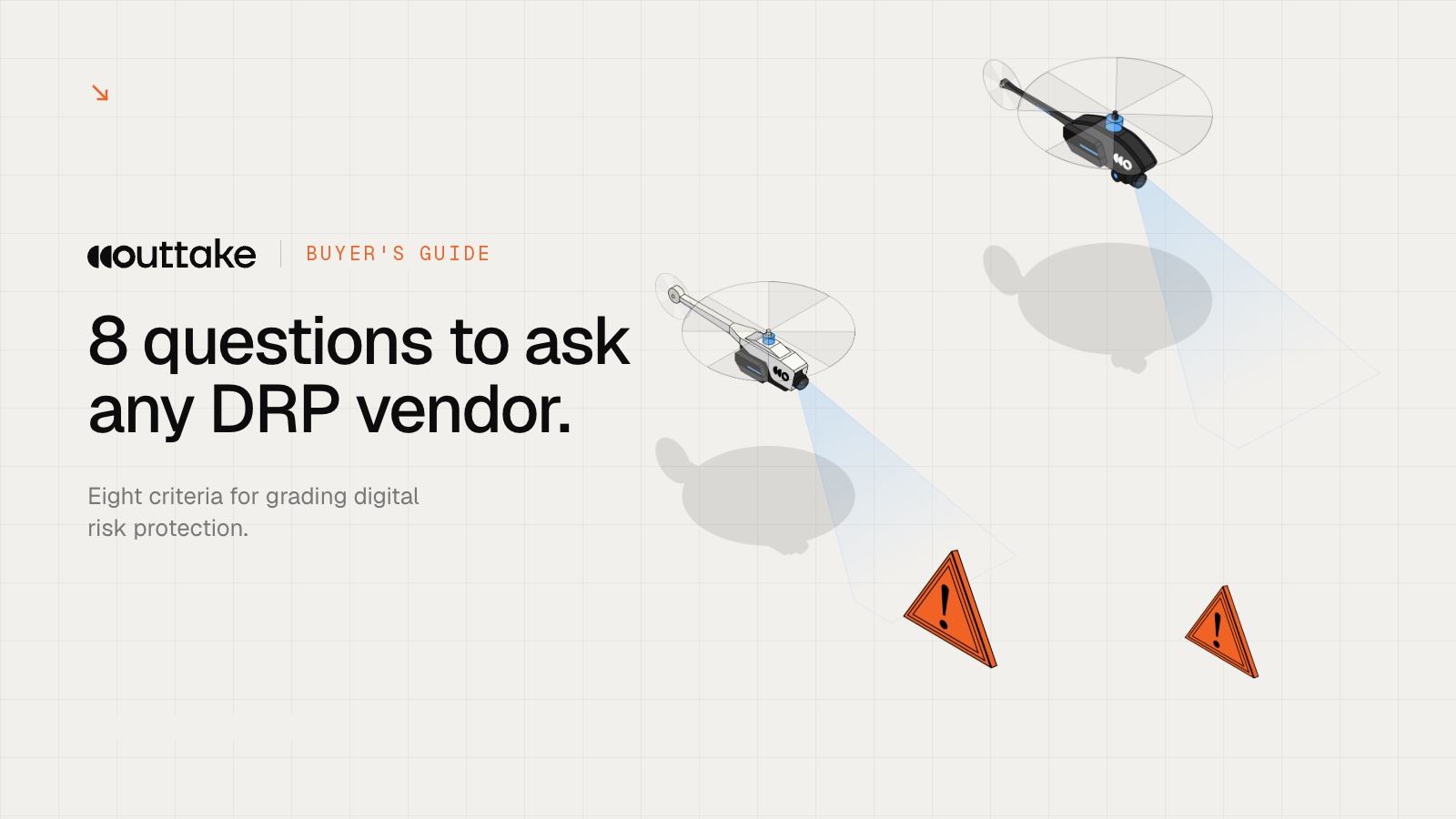
It hands you a standard you can run against every option on your list, including the platform you already own. Eight criteria. For each one, it shows you what good actually looks like, the exact gap to check for, and the question that exposes the difference in a live conversation. You stop grading vendors on the demo and start grading them on what they can prove.
The eight criteria
It ends with a one-page scorecard you can take into any evaluation, and ten questions short enough to bring to your next renewal. Walk in with these and the burden of proof shifts to the vendor, including the one you run today.
Where this leaves you
Put your shortlist through the eight and the whole picture comes into focus. You see each option as it really is, a set of capabilities that either hold up or do not, so you can weigh them side by side and decide where your budget and your team's attention will do the most good. Every vendor conversation turns toward what matters to your business, and you can tell which platforms are built to keep serving you as the ground keeps shifting.
That is what the guide is for: a clear, honest way to weigh your options and make a call you can stand behind.
Download it, run your shortlist through the eight, and pay attention to the questions that get a pause instead of an answer. Those are the ones worth chasing.
Eight criteria, a one-page scorecard, and ten questions short enough to bring to your next renewal.
Download the guideFrequently asked questions
What is Next-Generation Digital Risk Protection (NGDRP)?
NGDRP is the third generation of Digital Risk Protection. Rather than monitoring and alerting, it runs the full loop from detection through response, acts on the operation behind an attack instead of the individual fake, and improves the longer it runs. Your team sets direction and makes the judgment calls while the platform carries the volume.
How is NGDRP different from earlier DRP tools?
First-generation DRP is a managed service where analysts watch surfaces and file takedowns by hand. Second-generation tools automate detection but still hand each case to a person, one at a time. Next-generation DRP automates detection and response as one system, connects a single fake to the whole campaign behind it, and gets better with every case. A newer interface is not the same as a new generation.
What should I look for when choosing a DRP platform?
Hold every vendor to the same standard. The core criteria are complete coverage of your footprint, proactive detection before an attack launches, autonomous investigation you can trust, campaign correlation, whole-campaign takedown, intelligence that compounds over time, one platform across brand, people, locations, and products, and an architecture built to adapt as attackers automate.
Does DRP replace my other security tools?
No. DRP defends your external surface, the open internet where anyone can impersonate you. It complements the controls that protect your people and systems from the inside, such as email security and security awareness training. A vendor that claims to replace all of them is worth a closer look.
How is AI changing digital risk?
AI lets attackers create and spread convincing fakes at machine speed and near-zero cost, which moves the fight off your network and onto the open internet. As software gets harder to breach, the primary attack becomes convincing a person, or an AI agent acting for them, to trust something fake. Defenses now have to operate at the same machine speed to keep up.
Sources
1. Outtake, 2026 Digital Risk Report.
2. U.S. Federal Trade Commission, Consumer Sentinel Network Data Book, 2025.
Get the DRP Buyer's Guide
Eight criteria, a one-page scorecard, and ten questions for any vendor conversation.
What good looks like, the exact gap to check for, and the question that exposes the difference.
Grade every vendor side by side, including the platform you run today.
Short enough to bring to your next renewal, sharp enough to change the answer.