

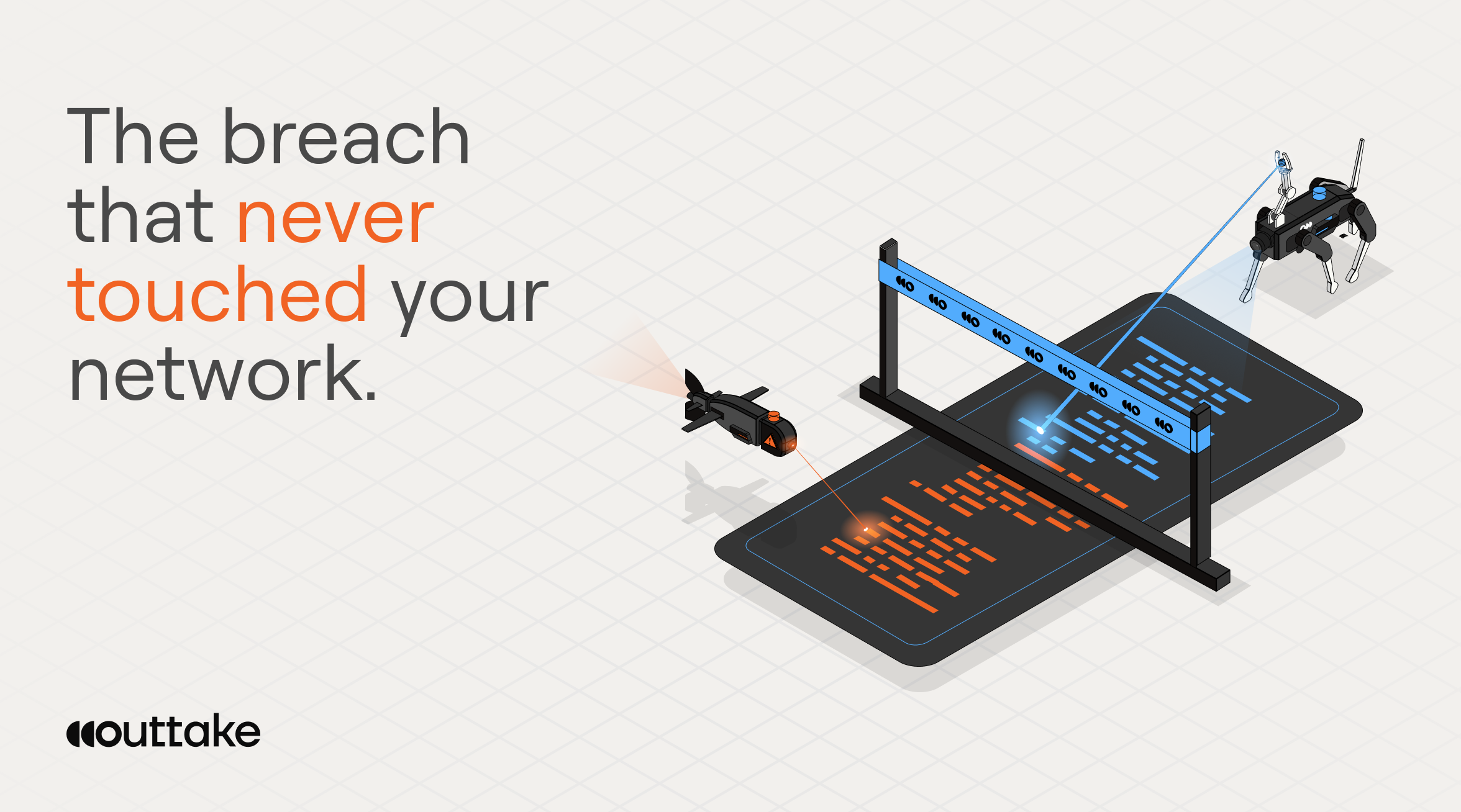

The Perimeter Didn't Die. It Expanded.

Digital trust is collapsing under the weight of AI-powered deception. The brands, executives, and institutions that survive will be the ones that stop reacting and start fighting back with the same weapons being used against them. AI vs. AI.
A few months ago, the CISO at one of the world's largest live entertainment companies sat down to review security operations and found something that stopped him cold.
More than ten scam domains were impersonating his brand in a single day. One event-themed fraud campaign had already netted $130,000 in fake ticket sales before anyone caught it.
He found it himself. His security tools didn't.
That story isn't a horror story about one unlucky company. It's Wednesday in 2026. It's what the world looks like when artificial intelligence falls into the hands of people who want to exploit the trust enterprises have spent years building.
[ 01 / THE THRESHOLD MOST ENTERPRISES HAVEN'T RECKONED WITH ]
The internet has already crossed a threshold most enterprises haven't fully reckoned with:
- 51% of global web traffic is now generated by bots (Source:
SRC / AU10TIX
37%
of that traffic is malicious
SRC / SLASHNEXT
+300%
surge in AI bot activity in twelve months
SRC / INDUSTRY DATA
This is the Agentic Internet, and it has fundamentally changed what it means to establish digital trust across an enterprise's most critical entities: brand, executives, affiliates, and products.
The market is at an inflection point. Digital trust — the invisible infrastructure that allows customers to believe that the account, the domain, the email, and the face on the screen actually represent the organization they claim to — is being systematically dismantled.
Security teams are no longer protecting infrastructure alone. They are protecting trust, brand integrity, and digital authenticity.
— THALES 2026 DATA THREAT REPORT
The market has named what Outtake was founded on: the perimeter is no longer a firewall. It's the entity.
[ 02 / THE NUMBERS DON'T LIE ]
The true scope of the threat shows up in the data. Not vendor marketing. Law enforcement agencies, security research firms, and federal cybersecurity watchdogs:
1,265%
surge in phishing since generative AI tools became widely available
72%
increase in AI-assisted attacks since 2024
$5.72M
average cost of an AI-powered breach in 2026
These aren't rounding errors or projections. They are operational realities documented by researchers tracking live threat campaigns.
And they're compounded by a structural problem that didn't exist three years ago: impersonation has become a service.
Today's attacker doesn't need to be a hacker. IaaS — Impersonation as a Service — providers now sell ready-made synthetic personas, tools that inject deepfake video directly into video calls, and voice cloning that requires just three seconds of audio to produce an 85% accurate match.
A CEO keynote posted to YouTube last quarter is enough source material to build a weapon.
Autonomous AI agents can run thousands of these impersonation attempts simultaneously, against customers, employees, partners, and boards. The attack surface didn't grow. It exploded.
[ 03 / ENTITY IS THE NEW PERIMETER ]
And it lives outside the firewall.
The cybersecurity industry spent the last decade perfecting the art of protecting things it controls: endpoints, networks, cloud infrastructure, identity access management. Zero trust became the rallying cry. MFA became table stakes.
And yet the most damaging attacks of 2025 and 2026 didn't breach a single firewall.
CASE_01 / ARUP
$25M
Lost without a single firewall touched
A finance worker in Hong Kong approved 15 wire transfers during what appeared to be a routine video call with their UK-based CFO and several colleagues. Every face on that call was a deepfake. No malware. No breach. No firewall event. Just a synthetic executive on a video call, and $25 million wired to criminals.
CASE_02 / COGNIZANT × SCATTERED SPIDER
$380M
Social engineering at enterprise scale
Hackers posed as an employee and fooled a Cognizant help desk into granting them account access. The social engineering attack became the focus of a $380M lawsuit. The same group targeted major U.S. enterprises using identical tactics. No exploits. No vulnerabilities. They wore the company's face instead.
The detection signals are gone.
Identity has become the defining security battleground of 2026, as attackers move from breaking into networks to exploiting trust, credentials, and automated workflows. AI-generated phishing and real-time impersonation are erasing the detection signals that security awareness programs relied on for a generation.
What that means in practice is uncomfortable. A CISO has invested millions in perimeter defense. SOC analysts are well trained. MFA is enforced. Meanwhile, a scam account using the company logo and the CEO's photo is operating on Instagram right now, routing victims to a phishing domain registered last Thursday.
The security stack will never see it. It lives entirely outside the walls the company has built.
The structural problem.
Traditional digital risk tools were built to catch what enterprises own and control. They monitor registered domains. They watch official social accounts. But AI impersonation attacks don't break systems. They exploit trust assumptions. They operate entirely in the space those tools weren't designed to see.
In this gray zone, the prevailing framing of identity as the new perimeter falls short. Entity is the real perimeter that needs protection.
The mentality has to change. Shift from an identity mindset to an Entity mindset.
[ 04 / THE DEEPFAKE EXECUTIVE PROBLEM ]
The deepfake CEO scenario is no longer theoretical.
Of all the threat vectors accelerating in 2026, one deserves special attention from anyone running an executive protection program or sitting in a CISO's chair. Attackers are using synthetic media to impersonate executives on live video calls to authorize fraudulent transactions or manipulate decisions.
Deepfakes now account for one in five biometric fraud attempts, and executive impersonation is becoming nearly indistinguishable from real human interaction.
— ENTRUST 2026 DIGITAL TRUST OUTLOOK
Most executive protection programs are built around physical security, personal travel risk, and access control. None of that protects against a convincing fake LinkedIn profile of a CFO soliciting wire transfers from vendors.
The CISO has a firewall. The executives have nothing.
[ 05 / WHY POINT SOLUTIONS KEEP FAILING ]
Here's the uncomfortable truth the digital risk protection industry doesn't want to say out loud: the tools currently deployed at most enterprises are losing this fight.
Not because the teams running them aren't talented. Not because the vendors don't care. Because the architecture was built for a different era. The incumbents were built around human analysts doing keyword-based monitoring and manually submitting platform takedown requests. That model worked when attacks were manual. It is structurally incapable of matching attacks that are AI-native and agentic in scale.
30%
of organizations now allocate dedicated AI security budgets — up from 20% last year
SRC / THALES 2026
53%
still rely on funding models not designed for AI-driven threats
SRC / THALES 2026
They are fighting a 2026 problem with 2021 tools. Gartner projects more than 1,000 legal claims for harm caused by AI agents will be filed against enterprises by end of 2026. Inaction is no longer a neutral position. It's an exposure.
[ 06 / AGENT VS. AGENT ]
The only way to win.
If the attack is agentic, the defense must be agentic.
There is no version of this story where a team of human analysts, scanning manually and submitting platform forms, outruns an adversarial AI running thousands of coordinated impersonation attempts simultaneously. The math doesn't work. The model doesn't scale.
We built Outtake because point solutions can't keep up with AI-driven deception. Enterprises are choosing a unified platform for digital trust, and this funding allows us to scale alongside customers as that shift accelerates.
— ALEX DHILLON, FOUNDER — SERIES B ANNOUNCEMENT
What makes an agentic approach categorically different isn't just speed. It's depth. Outtake's scanning doesn't find the scam account already known about and submit a takedown request. It maps the entire adversarial network: the fake domain that spawned three fake social profiles, which feed into a Telegram group, which connects to a fraudulent ad campaign running on Meta. And it dismantles it as a single connected campaign.
Not one incident at a time. The whole network. Simultaneously.
What Outtake does differently.
01 Continuous autonomous coverage. Millions of agents scanning social, web, dark web, messaging platforms, and domain registrars, twenty-four hours a day.
02 A unified threat graph. Every fake account, domain, ad, and persona tied to an attack mapped into a single visible network.
03 Direct enforcement relationships. Takedown channels with Meta, TikTok, and other platforms that move in hours, not weeks.
04 99.4% takedown confirmation. A documented outcome. Not a ticket status. Not a promise.
When the CISO at a major cybersecurity company sat across from the Outtake team after nearly a year on a competitor, the reaction wasn't complicated:
What you guys are doing — it's not even on the same sheet of paper.
— CISO, MAJOR CYBERSECURITY COMPANY
That isn't a sales quote. It's the direct result of a structural architectural difference. Agentic versus analyst-dependent. True AI versus AI-washed manual labor.
[ 07 / DIGITAL TRUST IS THE MISSION ]
It isn't a feature. It's the foundation.
When a customer clicks what they believe is the company's login page, they are extending trust. When a prospective hire applies through what they believe is the careers portal, they are extending trust. When an investor wires funds to what they believe is the company's treasury account, they are extending trust.
Every one of those trust assumptions is a target. The critical threat is 'agentic AI autonomy weaponized against soft targets,' and the only winning defense will be human-led and AI-scaled.
20M
potential cyberattacks scanned by Outtake systems last year
6×
ARR growth over the same period
10×+
growth in the enterprise customer base
Not because of marketing. Because the problem is real and the existing solutions are failing.
The brands that get hurt aren't the ones without a security team. They're the ones without visibility into the attack surface that lives outside their walls.
END_OF_PART_01
→
Learn why OpenAI, AppLovin, Pershing Square Holdings, and many more trust Outtake.
Request a meeting at outtake.ai/contact.
---
The conversation is happening. Join it.
Request a meeting at outtake.ai/contact
Outtake works with security and brand leaders at OpenAI, AppLovin, Pershing Square Holdings, and many of the world's most targeted enterprises.